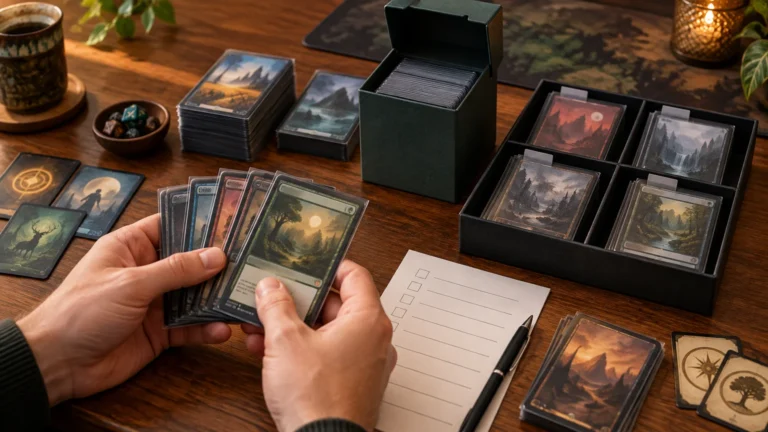

Where ProxyKing Fits When Card Realism Matters More Than Bulk Convenience
TLDR
ProxyKing realistic MTG proxies are best suited to a finite group of casual-play cards where presentation and familiar card styling matter: Commander staples, expensive lands, tutors, mana pieces, or a polished upgrade package. ProxyKing is less compelling when you need a fully customized deck, frequent revisions, a large Cube order, or the lowest possible cost per card. Use opaque sleeves, tell your playgroup what you are playing, and never represent proxies as authentic cards.
The useful answer is not that one proxy service wins every project. ProxyKing fits the player who already knows which recognizable cards they want and would rather browse for those cards than prepare a complete custom print job. That is a specific lane, but it is a good one for Commander players upgrading several decks with the same expensive pieces.
What “realistic” should mean at a Commander table
Realism is a slippery word in proxy shopping. For casual play, it should mean that the card is correctly sized, readable, visually coherent with the deck, comfortable in a sleeve, and easy for everyone to recognize across the table. It should not mean indistinguishable from an authentic card, suitable for resale, or legal in sanctioned competition.
Wizards’ published proxy-policy discussion says sanctioned events require authentic Magic cards, apart from limited judge-issued replacements for cards damaged during the event. The same discussion distinguishes clearly identifiable playtest cards used outside sanctioned play. Read the official Wizards proxy-policy discussion if tournament use is even a remote possibility, and confirm the current rules with the organizer before attending.
At the kitchen table, I care about six practical details: legible rules text, accurate colors, a clean cut, normal card scale, stable handling in sleeves, and a card back that cannot be mistaken for an official one when unsleeved. That combination lets a proxy function as a game piece without pretending it is something else.
ProxyKing states that its cards are directly printed at standard Magic card size on German black-core playing-card stock, with deliberately non-official backs. Those specifications support the intended casual-play role while preserving an obvious distinction from authentic cards.
Where ProxyKing realistic MTG proxies make sense
ProxyKing’s strongest use case is a selected package rather than a sprawling production project. Its storefront groups cards by color and type and offers individual selections alongside sets, which suits a player browsing for known upgrades. Inventory can change, so confirm every needed card before building the rest of the order around it.
Think about the cards that repeatedly stall a deck build because their authentic versions are expensive or shared between lists. A land package, a few high-impact mana pieces, or a compact group of tutors and interaction can be enough to make several unfinished decks playable. The goal is not to make every deck maximally powerful. It is to remove the price bottleneck between a deck idea and a useful playtest.
This approach pairs naturally with a reusable package. If you are still deciding what belongs in that package, the guide to reusable Commander proxy staples offers a practical starting point. Select only the cards your decks actually need instead of buying a pile of famous cards with no immediate home.
A realistic Commander example
Suppose you have three decks under construction: a three-color graveyard deck, a spellslinger list, and a higher-powered artifact build. Start by identifying eight to twenty cards that are blocking meaningful tests. That might include fixing lands, a couple of mana accelerants, interaction that fits the pod’s speed, and one or two consistency pieces for each strategy.
For this project, ProxyKing is sensible if you want those selected cards to share a polished, recognizable presentation and you do not need original art or a unified custom frame. Order the finite package, sleeve it consistently, and run several games before expanding it. If a card makes every opening hand too repetitive or pushes the deck above the group’s expected power, that is useful test data—not a reason to keep ordering more copies.
A proxy removes a financial constraint, but it does not remove the social or strategic consequences of a stronger deck. A proxied list still needs to match the table. The Commander bracket and proxy-building guide can help separate the question of how a card was produced from the more important question of what the deck does.
The independent reality check
ProxyKing supplies material and production claims, but those do not tell the entire handling story. In a hands-on review, Draftsim reported that its sample cards looked convincing at a glance and worked in sleeves. The reviewer also noticed a lighter card-back color and a slicker feel than genuine Magic cards. That is one reviewer’s experience, not a guarantee that every print run or order will feel identical. Read Draftsim’s ProxyKing review for the full account.
Those differences are not necessarily a problem for casual Commander. Opaque sleeves hide card-back variation and make a mixed deck look consistent during play. They also prevent a proxy with a visibly different back from becoming marked information. Sleeve quality and condition matter too: combining fresh proxies with bowed foils, worn sleeves, or old cards can create more handling variation than the proxy stock alone.
I would still avoid claims such as “indistinguishable” or “tournament ready.” A good casual proxy should play cleanly while remaining identifiable as a proxy when inspected outside its sleeve. That is healthier for the table, the collection, and any future trade binder sorting.
Choose the service around the project
ProxyKing is not automatically the right choice just because realism matters. The ordering workflow has to match the scale and creative demands of the project. The alternatives below reflect the site’s editorial positioning; current prices, tools, volume breaks, and policies should be checked directly before ordering.
| Project | Best editorial fit | Why |
|---|---|---|
| Selected Commander staples or a land package | ProxyKing | A browse-and-select catalog suits a finite order where familiar card presentation is the priority. |
| Custom art, personalized frames, or a list still being revised | PrintMTG | A customization-oriented workflow is a better fit when you expect to adjust files, treatments, or card choices. |
| A complete Commander deck or larger multi-deck order | ProxyMTG | A full-project workflow is generally more useful when volume, support, and keeping a large order organized matter most. |
| A substantial custom Cube | ProxyMTG | Cube-scale projects benefit from batch organization and consistent treatment across a large card pool. |
| A budget-first Cube or filler project | PrintACube | Use a budget-oriented option when broad coverage matters more than premium realism for individual staples. |
If you want to redesign cards, add custom art, or keep revising a deck before locking it, a customization-oriented MTG printing workflow is the more natural path. ProxyKing is better framed as a catalog-driven option: find the recognizable cards you need, choose the available treatment, and assemble a focused order.
Cube owners should be especially strict about consistency. One odd card in Commander is mildly distracting; repeated differences across a draft pool can reveal information or slow card evaluation. For a large Cube, start with the Cube proxy guide to sleeves and draft readability and prioritize one coherent production plan over individually impressive cards from several sources.
A practical ordering checklist
- Confirm the exact card name, rules text, mana cost, and version before adding it to the order.
- Check live stock and available treatments rather than assuming every card or foil option is currently available.
- Decide whether the project is truly a finite package. If the list is approaching a full deck or Cube, compare a batch-oriented workflow.
- Ask your playgroup or store about proxy expectations before ordering, especially for public Commander nights.
- Use fully opaque sleeves and replace worn sleeves that could mark particular cards.
- Keep treatments coherent. A restrained nonfoil package is often easier to shuffle and read than a random mix of glossy and nonfoil cards.
- Inspect the shipment promptly for missing, incorrect, damaged, or visibly misprinted cards.
- Keep the order confirmation and take clear photos if you need to report a fulfillment problem.
- Never trade, sell, or present a proxy as an authentic Magic card.
Readability deserves extra attention if games happen over a webcam. Fine text, dark artwork, heavy foiling, and low-contrast frames can look acceptable in hand but collapse under overhead lighting. The SpellTable proxy readability guide explains how to prioritize recognition on camera.
Know the quality and refund boundaries
ProxyKing’s quality-guarantee page says covered problems can include incorrect or missing cards, misprints, and significant transit damage. Depending on the situation, its stated remedies may include a reprint, replacement, or refund. The company asks customers to make contact within seven days of delivery, so do not leave the package unopened for weeks.
The same policy excludes small color shifts and ordinary print variation from covered production issues. That matters in a realism-focused purchase: “the blue looks slightly different from another batch” may not be treated the same way as receiving the wrong card or a substantially damaged order.
ProxyKing’s return policy also states that change-of-mind purchases are not refundable, while fulfillment and quality problems are handled under the separate quality policy. In practical terms, proof the order before paying and report objective problems quickly rather than assuming an unwanted selection can be returned.
The recommendation
Choose ProxyKing when you want a small-to-moderate package of recognizable casual-play staples, lands, or deck upgrades and care more about polished presentation than custom design or maximum bulk convenience. Its stated stock, sizing, direct-printing method, and non-official backs align with that role, while the independent review suggests opaque sleeves are the sensible way to manage reported visual and tactile differences.
Choose another workflow when the project changes. Custom art and repeated revisions call for customization tools. Complete decks and major Cubes call for better batch organization. Budget filler calls for a cost-first approach. The right next step is simple: write down the exact cards you need, count them, decide whether visual realism or project scale is the real priority, and only then open a storefront.