Best Way to Proxy MTG Cards for Casual Play: Paper, Sleeved Inserts, or Printed Cards
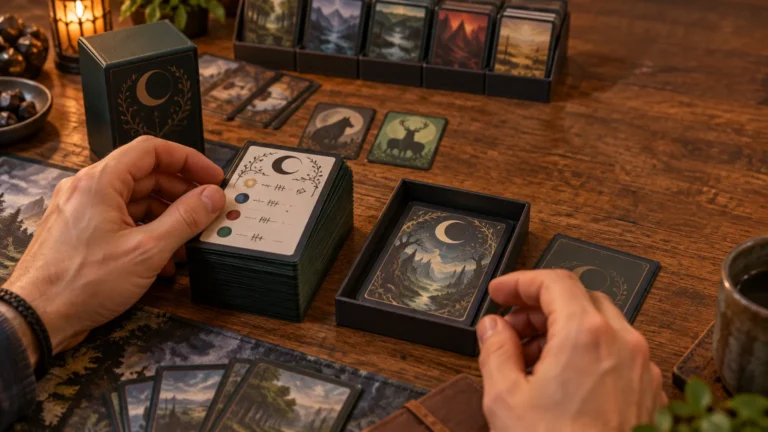
For most casual players, the best way to proxy MTG cards is to print thin paper faces, place each one in front of a normal Magic card or bulk card, and use matching opaque sleeves throughout the deck. It is inexpensive, easy to revise, and consistent enough for repeated Commander testing.
Professionally printed cards become the better choice once the list is stable, the deck gets played regularly, or the project is a Cube that needs to survive drafting and constant reshuffling. Handwritten paper is fine for tonight’s test game, but it is a temporary solution rather than a satisfying deck.
The quick comparison
| Format | Best use | Shuffle feel | Durability | Main drawback |
|---|---|---|---|---|
| Handwritten paper or basic lands | Immediate one-night tests | Acceptable when sleeved consistently | Low | Harder to read and visually messy |
| Printed paper inserts with backing cards | Brewing and revising Commander decks | Good with uniform paper, backing cards, and sleeves | Moderate | Cutting and assembly take time |
| DIY heavy stock or laminated cards | Longer-term home projects | Variable; cutting and thickness matter | Moderate to high | Small differences can make cards identifiable |
| Professionally printed cards | Stable decks, full lists, and Cubes | Most card-like and consistent | High | Higher cost and slower to revise |
Sleeved paper inserts are the best default
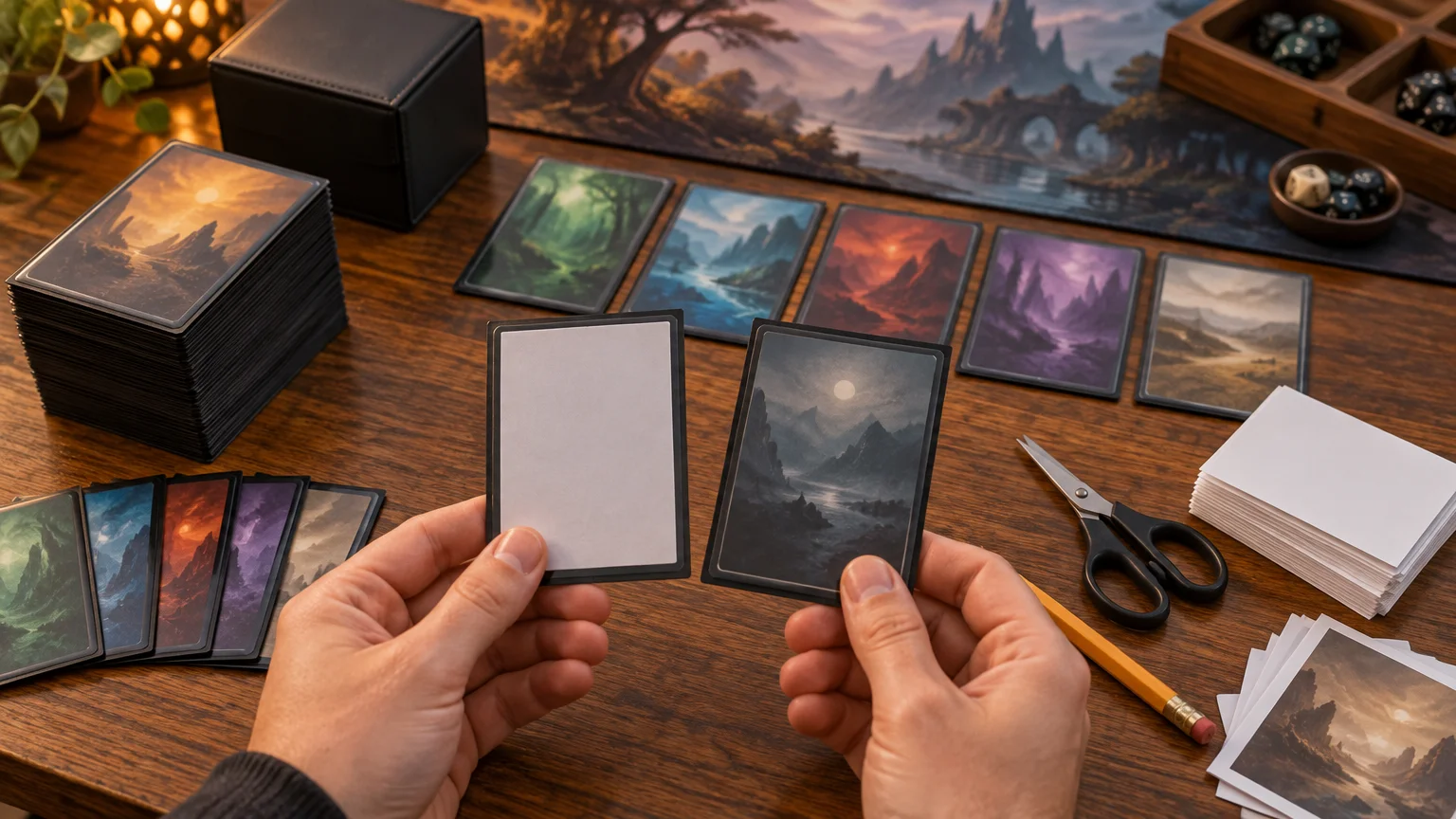
The ordinary paper-in-sleeve method wins because it solves the actual playtesting problem without pretending every first draft deserves permanent production. Print the card face at normal size, trim it, place it in front of a basic land or bulk card, and sleeve the complete stack.
Wizards gives both writing another card’s name on a basic land and placing a printed slip in front of a card inside a sleeve as examples of personal, non-commercial playtest cards. Its policy says it does not seek to police that kind of use outside sanctioned events. You can read the distinction in Wizards’ policy on proxies and playtest cards.
The backing card supplies most of the structure. Ordinary printer paper alone is too flexible, easy to crease, and potentially transparent. Wizards describes playing-card board as laminated material made to bend and shuffle without creasing, with a dark center layer that contributes opacity. A paper insert does not reproduce that construction, but a normal card and opaque sleeve compensate for the weaknesses that matter during casual play. Wizards’ explanation of playing-card board covers the underlying construction.
Build the whole deck the same way
Consistency matters more than whether the proxy face came from a premium printer. If ten proxies contain thick photo paper while the other cards contain nothing extra, you may be able to find those ten cards by touch. The same problem appears when some inserts are folded, doubled, laminated, or cut with large overlaps.
- Use opaque sleeves that completely conceal the card backs.
- Print every face at the same scale.
- Trim away paper that catches near the sleeve opening.
- Use flat, undamaged backing cards of similar thickness.
- Insert every card in the same orientation.
- Replace bent sleeves, split sleeves, and badly creased inserts.
- Shuffle the finished deck and check whether any card can be identified by touch or from the back.
Handwritten proxies are for speed, not comfort
A basic land with “Rhystic Study” written across it can answer an urgent deck-building question: does this card improve the list enough to keep? That is a perfectly reasonable game piece for a quick test among players who know what is happening.
It becomes awkward when the card has several abilities, unusual timing, unfamiliar creature stats, or wording that matters. Every pause to look up the real text slows the table and weakens the test. You are no longer evaluating only the card; you are also evaluating everyone’s patience.
Use handwritten cards for familiar staples, simple effects, or a few last-minute substitutions. For anything information-heavy, print a readable face. Card name, mana cost, type line, rules text, and combat information should remain legible at actual card size and from a normal seat at the table. If you are choosing custom frames or alternate treatments, the same principle drives this guide to readable alternate-art proxies.
Heavy stock and lamination create new consistency problems
Printing directly on heavier stock sounds like the obvious upgrade because it removes the backing card. In practice, it shifts the hard work to paper selection, cutting, corners, opacity, and surface finish.
Community discussions describe heavy stock, sticker paper, and lamination as workable DIY routes, but they repeatedly flag cutting precision and uniform thickness as practical problems. Those reports are anecdotal rather than controlled product tests. A fractionally oversized card may resist entering a sleeve, while uneven corners can catch during shuffling. Lamination can also make a proxy substantially thicker than the surrounding deck.
This approach makes the most sense when crafting is part of the appeal and the entire deck will use the same construction. It is less attractive for inserting five homemade cards into an otherwise ordinary Commander deck.
When professionally printed cards are worth it
Move to printed cards when you have stopped asking “Does this card belong in the deck?” and started asking “How do I make this deck pleasant to use every week?” A complete printed stack avoids loose paper edges, reduces assembly work, and gives the project a more coherent appearance.
Card construction matters here. Wizards explains that coatings protect cards from moisture, scuffing, wear, and finger oils while balancing slip and grip during handling. Its overview of playing-card coatings is a useful explanation of why surface finish affects more than shine. Vendor claims about black-core stock, coatings, and die cutting address the same practical concerns—opacity, durability, sleeve fit, and consistent handling—but they should be treated as specifications rather than independent comparative test results.
For a finished deck or large Cube, a service offering professionally printed MTG playtest cards can remove the trimming and assembly stage. For a smaller order or a project requiring original card text and artwork, PrintMTG’s Card Maker includes editable names, mana costs, type lines, rules text, frame choices, and art controls. PrintMTG is therefore the more natural fit when customization is central or the list is still being revised. ProxyFoundry fits established decklists, complete decks, and larger Cube projects where selecting existing printings is the main task.
Before sleeving a delivered order, count the cards, check the cuts, inspect text at actual card size, and look for inconsistent color or finish. The finished proxy order inspection checklist covers that process in detail.
Cube demands stricter consistency than Commander
Commander can sometimes tolerate one odd insert because its location remains hidden in a sleeved library. Cube adds drafting, repeated handling, and many players who may not recognize every card. Differences in thickness, card backs, or sleeve behavior can reveal information before a card is selected.
For a Cube, I would choose one construction method for the entire environment. Use uniformly assembled paper inserts while testing the list, then print the full Cube once archetypes and card choices have settled. Avoid upgrading isolated sections unless the finished cards remain indistinguishable through the sleeves. The same discipline applies to double-faced cards, which need opaque sleeves and a consistent reference or placeholder system; this double-faced proxy setup guide explains the practical options.
Casual permission does not make proxies tournament legal
These recommendations apply to personal playtesting and casual games where the group accepts proxies. They do not apply to sanctioned Magic events. The Magic Tournament Rules require genuine, publicly released Magic cards, apart from narrow circumstances in which a Head Judge issues a tournament proxy. The rules also require consistent sleeve use and allow worn, marked, or gameplay-interfering sleeves to be rejected.
For casual Commander, have the proxy conversation before shuffling up. The physical quality of the card does not determine whether its power level suits the table. A polished proxy of an oppressive card is still an oppressive card; a paper proxy of a modest land is still a modest land.
A practical recommendation for your next deck
Start with sleeved paper inserts backed by bulk cards. Print the full rules text, assemble every proxy the same way, and play enough games to identify which cards actually survive revision. This is the best balance of speed, price, readability, and honest testing for most Commander decks.
Once the list settles, decide whether the deck has earned a permanent version. Keep paper inserts for a list that changes every week. Choose professionally printed cards for a favorite Commander deck, a stable full-deck build, or a Cube that will be drafted repeatedly. The best proxy is not automatically the fanciest one—it is the version that lets the deck shuffle cleanly, read quickly, and reach the table sooner.
References
- On Proxies, Policy, and Communication | MAGIC: THE GATHERING
- Playing Card Board | MAGIC: THE GATHERING
- MTG Proxy Art: Choose Alternate Art That Still Reads Across the Table – coftable Design and Print
- what is the best printer for $500 or under to print proxies? And the best card stock for printing proxies?
- Playing Card Coatings | MAGIC: THE GATHERING
- PrintMTG
- Print Proxies | Proxy Foundry
- Card maker | PrintMTG
- Double-Faced MTG Proxies and Helper Cards: The Least Awkward Table Setup – coftable Design and Print
- MAGIC: THE GATHERING® TOURNAMENT RULES