Goldfishing vs Real Games: What Each Type of Deck Test Can Tell You
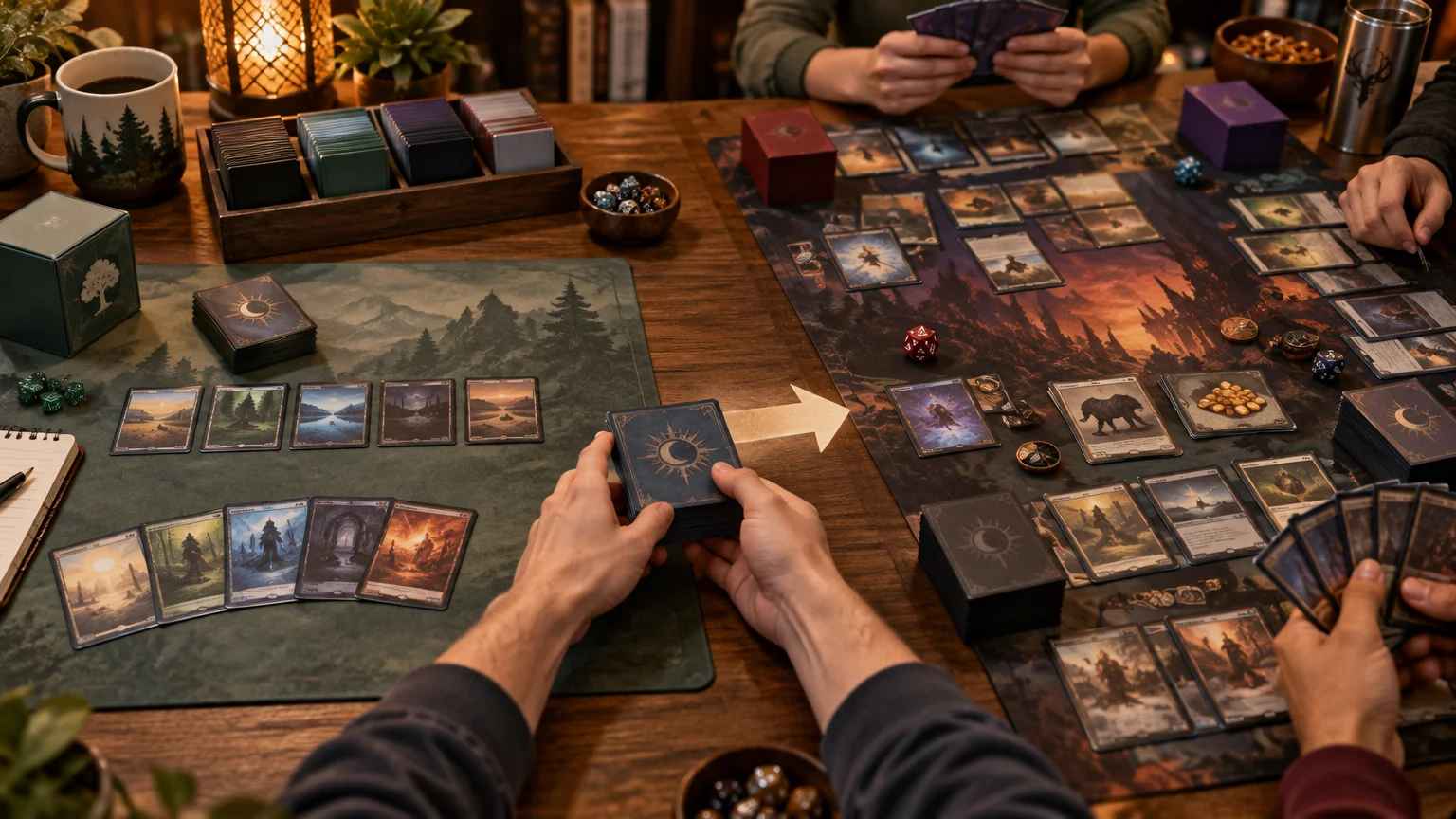
Goldfishing and real-game playtesting answer different questions. Goldfishing tells you whether your Commander deck can execute its basic plan when nobody interferes. Real games tell you whether that plan still matters after three opponents start removing pieces, developing threats, and making inconvenient decisions.
Use solo tests to diagnose the deck’s machinery: opening hands, land drops, color access, ramp, sequencing, commander timing, and dead cards. Then use multiplayer games to test interaction, resilience, threat assessment, recovery, and whether your supposed win condition survives contact with an actual table. Goldfishing is the workshop. A pod is the road test.
What goldfishing can tell you quickly
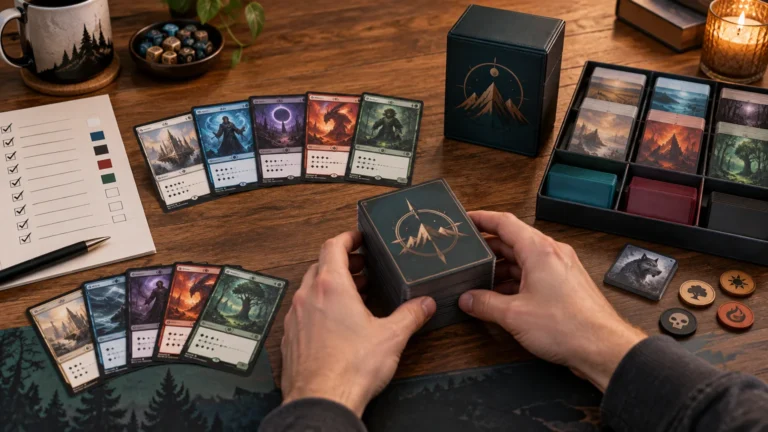
Goldfishing means playing your deck without an opponent. Icarian’s goldfish-testing guide presents it as a way to examine mana curve, land count, dead hands, ramp timing, and clunky turns. Those are exactly the areas where solo testing earns its keep.
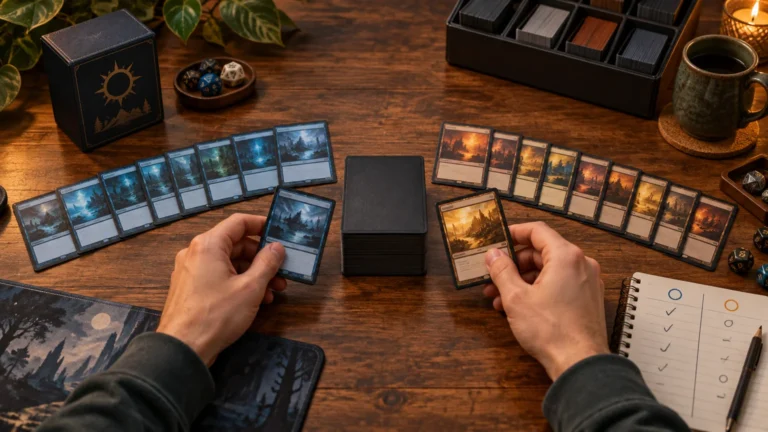
Commander’s 100-card singleton construction creates plenty of draw-to-draw variation, so one attractive opening hand proves very little. Repeated hands are more informative. If six of ten starts leave you unable to produce a second color, that is a useful warning. If your four-mana commander routinely arrives on turn six because every ramp spell costs three, the deck is showing you a structural problem rather than suffering one unlucky draw.
A clean solo test should track a few concrete questions:
- Would you keep the opening hand under normal Commander mulligan rules?
- Can the deck make its early land drops and produce the colors its spells require?
- When can it cast its commander without abandoning every other development play?
- Does the curve offer useful sequencing, or do several cards compete for the same turn?
- When does the deck gain access to repeatable draw, interaction, or its main engine?
- Which cards repeatedly sit in hand because their conditions are too narrow?
Commander begins with a seven-card hand, and multiplayer Commander gives each player one mulligan without reducing the next hand’s size. Use those actual rules rather than quietly giving the deck unlimited free redraws until it behaves. Otherwise, you are testing its best presentation instead of its normal keep decisions.
What a solo game cannot prove
A smooth turn-five engine is not the same thing as a good turn-five board. In a goldfish test, your commander survives, your graveyard remains available, and the creature carrying three pieces of Equipment never meets a blocker. That is useful as a baseline, but it is a flattering baseline.
Commander is normally multiplayer, with players able to attack and target one another. That introduces removal, counterspells, blockers, board wipes, competing engines, and changing threat assessment. None of those pressures exists in solitaire testing. Wizards’ Commander format overview describes the format’s multiplayer structure and also points players toward pregame discussion tools for aligning the intended experience.
Most importantly, a goldfish “win turn” is not a prediction. If a deck can assemble a deterministic line on turn seven without resistance, you have learned that its pieces and mana can converge by turn seven. You have not learned that the table will let the critical permanent survive, that you can protect the line, or that another deck will not force you to spend mana interacting first.
| Test question | Goldfishing | Real Commander games |
|---|---|---|
| Can I keep enough opening hands? | Very useful | Useful, but slower to sample |
| Does the mana support my curve and colors? | Very useful | Useful, with game pressure added |
| Can I sequence my setup efficiently? | Very useful | Useful, but opponents may disrupt the sequence |
| Does the deck survive removal and wipes? | Only with artificial assumptions | Essential |
| Is my interaction relevant at the right time? | Limited | Essential |
| Do opponents recognize and stop my threats? | Cannot test | Essential |
| Can the deck recover after falling behind? | Weak simulation | Essential |
| Does the deck fit the pod’s expected experience? | Cannot establish | Essential |
Real games test resilience, not just speed
A real pod reveals whether your deck functions when the easy sequence disappears. Perhaps the commander gets removed twice. Casting it again from the command zone costs an additional two generic mana for each previous command-zone cast, so a strategy that depends entirely on its commander can become dramatically slower after early interaction. Goldfishing the commander on curve does not measure that weakness.
Multiplayer games also show whether your answers match the problems you actually face. A hand containing three efficient creature-removal spells may look responsible during deck construction. At the table, it can feel embarrassingly incomplete when the dangerous cards are enchantments, graveyard engines, or a protected combo. Likewise, a wipe that looks slow in isolation may be the card that lets you reset two faster starts and recover.
Politics and threat perception matter too. A value engine can be mechanically efficient yet attract more attention than the deck can absorb. A commander may signal a combo before you have drawn any part of it. These are not flaws that solitaire play can reveal because they emerge from what other players know, fear, and choose to target.
Match the tests to the kind of table where you expect to play. A deck intended for a relaxed battlecruiser pod needs different evidence than one built for a fast, highly interactive environment. If you are unsure how the list communicates its intended experience, the site’s guide to building proxy decks for Commander brackets can help frame that pregame conversation.
Use stress tests without pretending they are opponents
You can make goldfishing less generous by adding simple stress conditions. On one run, assume your commander is removed the first time it resolves. On another, put a board wipe on a fixed turn. You might also require the deck to hold up interaction rather than spending every available mana on its own plan. Commander players report using variations like these to expose fragile sequencing and commander dependence.
A practical testing sequence for a new deck
I would not take a fresh 100-card pile straight to a dozen games and hope the problems explain themselves. Start cheaply, remove the obvious mechanical faults, and save pod time for questions that require a pod.
- Draw ten opening hands. Apply normal mulligan decisions and record why each hand is keepable or not.
- Play at least several hands through the early setup turns. Note missed land drops, color problems, unused mana, and when the commander can reasonably enter.
- Continue a smaller number of runs until the deck establishes its engine or reaches a plausible finishing line. Record cards that repeatedly remain stranded.
- Add stress conditions to a few runs: remove the commander, answer the main engine, or impose a board wipe.
- Make only the clearest corrections before multiplayer testing. Avoid replacing fifteen cards because of one ugly draw.
- Play real games in the intended environment. Track what stopped the deck, which answers were missing, and whether opponents reacted to threats the way you expected.
- Change a small group of cards, then repeat. For a controlled approach, use the ten-slot Commander A/B testing method instead of rebuilding the deck after every memorable loss.
Proxies make this process much easier because uncertain cards do not need to earn a purchase before they earn a test. Handwritten inserts are enough for early mechanical checks. When you want a readable physical stack for repeated shuffling and pod games, printmtg.com is an option for printed MTG playtest cards and custom card designs.
Judge patterns, not dramatic moments
The hardest part of Commander testing is resisting the story told by one game. A card that wins spectacularly once may have been dead in four earlier hands. A land that enters tapped may look harmless until repeated tests show it delaying the commander or interaction at the same critical point. Conversely, a protection spell that appears boring during goldfishing may prove indispensable once opponents start aiming removal at your engine.
Record recurring friction in plain language: “missed third land,” “commander cast with no protection,” “draw engine arrived after hand emptied,” or “removal could not hit the relevant permanent.” Those notes lead to deck changes. “Deck felt bad” does not.
The useful division is simple: goldfish until the deck can reliably do its job, then play real games to learn whether it is allowed to do that job and whether it can adapt when it is not. Fix mana and sequencing alone. Test interaction and resilience with people. When both stages point to the same weak slot, you can make the change with far more confidence.