
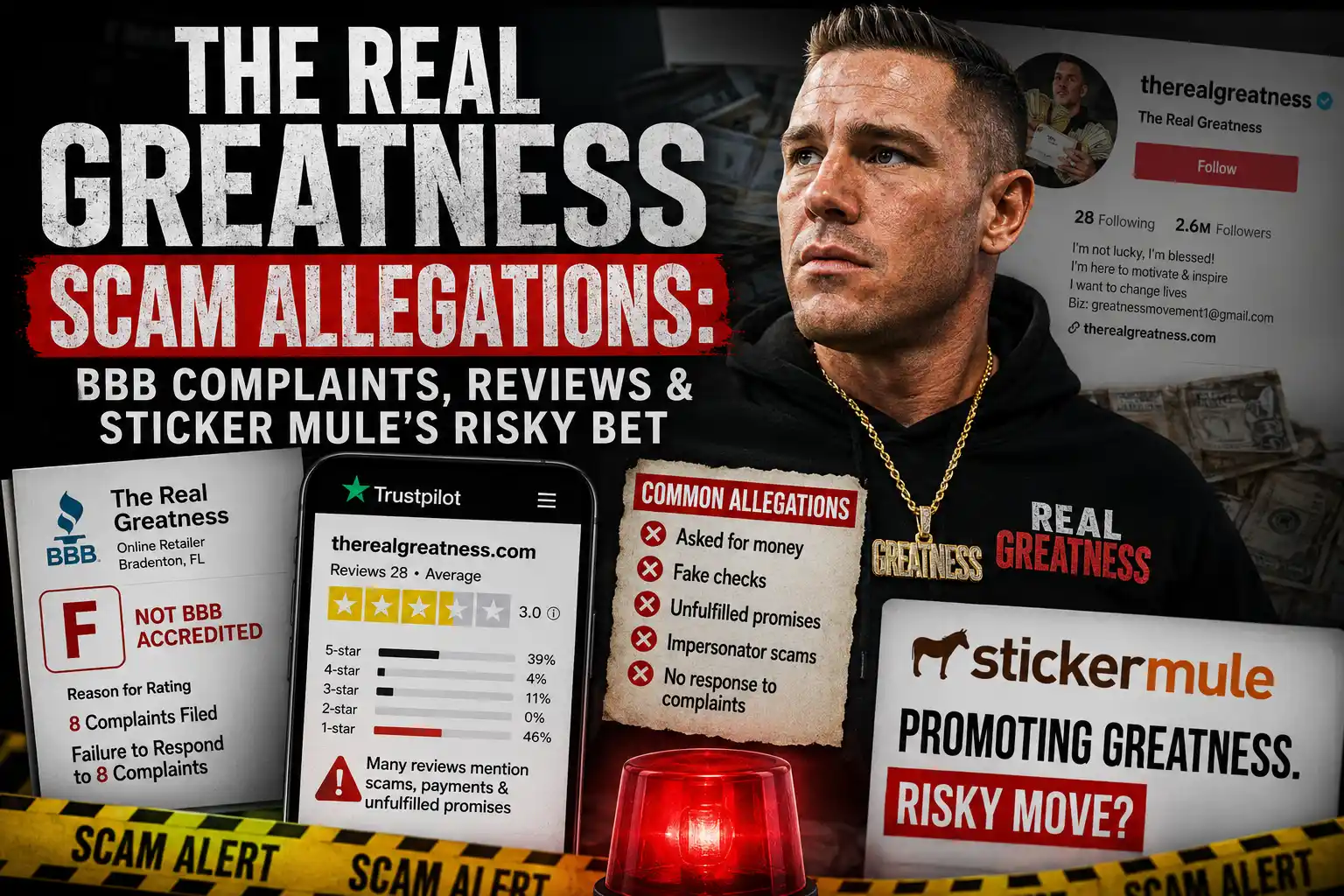
The Real Greatness Scam Allegations: BBB Complaints, Reviews, and Sticker Mule’s Risky Bet
TLDR
The Real Greatness, also known as Jason Jensen, is surrounded by serious public trust problems. The strongest documented issues include BBB F ratings, unresolved complaints, negative customer reviews, scam-related allegations and confusion around fake accounts using his name.
That does not automatically prove a legal fraud finding. But it does make Sticker Mule’s decision to promote him look reckless. The fake-account defense may explain some scams, but it does not answer the bigger question: why would a major brand attach itself to a personality with this many public red flags?
The Real Greatness Problem Is Bigger Than Fake Accounts
The Real Greatness story is usually framed one of two ways. Fans see Jason Jensen as a viral giver who hands out money, builds a movement and turns generosity into content. Critics see something much darker: a personality surrounded by scam allegations, unresolved complaints and a “blessing” model that appears to blur the line between charity, marketing and paid hope.
The phrase The Real Greatness scam allegations matters because this is not just about random fake accounts. Fake accounts do appear to be part of the story. The official Greatness site itself claims he is “the Internet’s most imitated influencer” and says there may be tens of thousands of fake accounts using his name or image. That is a real issue.
But it is not the whole issue.
The bigger issue is that public complaints and reviews are not limited to anonymous impersonators. The official business profiles tied to The Real Greatness carry serious warnings. BBB lists The Real Greatness as not BBB accredited and gives the business an F rating. BBB also lists Tour Life, LLC with “The Real Greatness” as an alternate name and names Jason Jensen as owner, principal contact and customer contact. That profile also has an F rating.
That is the part that should make people stop.
A creator can claim scammers are impersonating him. That may be true. But when the official business reputation also has unresolved complaints and public review platforms include allegations involving money, “blessings,” fake checks, upfront payments and unfulfilled expectations, the story becomes much harder to wave away.
What BBB Says About The Real Greatness
The strongest source in this whole story is the Better Business Bureau.
BBB’s profile for The Real Greatness lists the business as an online retailer in Bradenton, Florida. It says the business is not BBB accredited. More importantly, BBB gives The Real Greatness an F rating. The stated reasons are simple and damaging: failure to respond to 8 complaints filed against the business, and 8 complaints filed against the business.
That does not mean BBB has legally ruled that The Real Greatness committed fraud. BBB is not a court. But an F rating based on unanswered complaints is still a major trust signal. It tells consumers that complaints exist and, according to BBB, the business failed to respond to them.
A second BBB profile makes the situation even harder to dismiss. Tour Life, LLC is also listed as an online retailer. BBB gives it an F rating for the same reasons: 8 complaints filed and failure to respond to 8 complaints. The profile lists “The Real Greatness” as an alternate name and names Jason Jensen as owner, principal contact and customer contact.
That connection matters.
It means this is not just a vague internet rumor. There are business profiles, alternate names and named management details connecting Jason Jensen, Tour Life, LLC and The Real Greatness. When a business connected to a public giveaway personality has unresolved complaints and an F rating, consumers are right to ask questions.
The Trustpilot Reviews Add More Red Flags
Trustpilot is not a court either. Reviews can be emotional, incomplete or even unfair. Trustpilot also states that it does not fact-check every specific claim in reviews. That needs to be said clearly.
But even with that caveat, the Trustpilot profile for therealgreatness.com is not reassuring.
As of this review, Trustpilot shows 28 reviews, a 3.0 average rating and 46% 1-star reviews. Trustpilot also says the company has no history of asking for reviews, meaning the reviews may not represent the full customer base.
The actual review themes are the problem.
Some reviewers describe sending money to someone claiming to be Greatness. Some warn about people promising help and then wanting money. Some accuse the brand directly. One reviewer says they spent money “in an attempt to get blessed.” Another describes a fake-check type situation. Several reviews use direct scam language.
Again, these are allegations from reviewers. They are not legal findings.
But when a public figure builds a brand around giving away money, selling merchandise, offering “blessings” and creating hope-driven viral content, those allegations matter. This is exactly the kind of model where people can become confused about what is real, what is marketing, what is a contest, what is a purchase and what is a scam.
That confusion is not a side issue. It is the issue.
The Fake Account Defense Is Not Enough
The Real Greatness and his supporters often point to fake accounts. They say scammers are using his face, name and videos to trick people. There is evidence that fake accounts exist. His official site says fake Greatness accounts are everywhere and claims Sticker Mule has provided legal support to fight imitators.
That defense may explain some complaints.
It does not explain all of them.
The problem with the fake-account defense is that it tries to shrink a broad trust issue into a narrow impersonation issue. If a fake account messages someone and asks for money, that is clearly an impersonator scam. But when public complaints are tied to official business profiles, when the official brand has BBB F ratings and when reviewers talk about spending money through the brand or expecting “blessings,” the issue becomes harder to separate.
A responsible brand would make the rules brutally clear:
You never pay to receive a blessing.
You never send gift cards.
You never pay a processing fee.
You never send Cash App, crypto or bank details.
You never deposit a check and send money back.
You never trust a direct message just because it uses a familiar face.
The official Sticker Mule Give platform actually says its giveaways require no account, no payment and no strings attached. That is good language. But it also creates a sharp contrast with the broader Greatness ecosystem, where many allegations involve people believing money, gifts or blessings might be coming if they first pay, buy or cooperate.
That is a dangerous fog.
Why the “Blessing” Model Creates Scam Risk
The core marketing idea behind The Real Greatness is simple: give money away, film it, go viral, sell the movement.
That is powerful content. It is also risky content.
Most people know not to trust a random stranger promising free money. But influencer culture changes the math. If someone has millions of followers, polished videos, luxury cars, cash giveaways and major brand partnerships, people lower their guard. The promise feels more believable because the person looks successful.
That is why “blessing” marketing is so vulnerable to abuse.
The Federal Trade Commission’s general guidance on prize and sweepstakes scams is clear: if you have to pay to get a prize, it is a scam. Real prizes are free. The FTC also warns that fake checks can take weeks to unwind, and by the time the bank discovers the check is bad, the victim may already have sent money and be stuck repaying the bank.
Those warnings line up with the themes in public reviews: upfront payments, promised help, checks, money movement and confusion over whether the person contacting them is real.
Even if The Real Greatness is not personally behind every bad message, the public brand creates the bait. The face, the cash, the promises and the “you could be next” energy are what make the scam believable.
That is why the response cannot just be “there are fake accounts.” The better question is: why does this model make fake accounts so effective?
Sticker Mule’s Role Makes This Worse
Sticker Mule’s involvement turns this from an influencer trust problem into a brand-safety problem.
Sticker Mule publicly promoted Greatness as the frontman for its Multi-Million Dollar Giveback Initiative. Its own press release said early Greatness videos generated more than 13 million views across platforms in 24 hours and more than doubled Google searches for “Sticker Mule.” Sticker Mule also described Greatness as someone who built a social media empire by giving back his own money to create viral videos.
That explains the business motive.
Sticker Mule is using Greatness because he gets attention. He creates viral videos. He makes people talk. He pushes the company into feeds that ordinary sticker ads would never reach.
But attention is not the same as trust.
Sticker Mule also launched Give, a platform designed to help people run giveaways and build email lists. In its own announcement, Sticker Mule said Give lets people run giveaways, collect entry data and encourage entrants to buy from the host’s store after entering. That makes the Greatness partnership even more concerning, because it connects a public figure with scam-related allegations to a formal giveaway and marketing infrastructure.
This is where the criticism gets very simple.
Sticker Mule is not just watching from the sidelines. Sticker Mule is amplifying him, monetizing the attention and hosting a verified Real Greatness store on its own marketplace. That gives the partnership a layer of legitimacy.
And that legitimacy matters to consumers.
When people see a major company promote someone, they assume that company has done some level of due diligence. They assume the person has been vetted. They assume the partnership is safe. Maybe they should not assume that, but they do.
That is what makes this so reckless.
What Can Be Fairly Said and What Should Be Avoided
A careful article should not say Jason Jensen has been legally found guilty of fraud unless there is a court record, regulatory action or criminal conviction proving that. Based on the public information reviewed here, the safer and more accurate phrasing is:
The Real Greatness is surrounded by scam allegations.
The official business has BBB F ratings and unresolved complaints.
Public reviews include serious scam-related claims.
The fake-account defense does not answer every concern.
Sticker Mule’s promotion of Greatness creates a serious brand-safety issue.
Those statements are strong enough. They do not need to be inflated.
Calling someone a “confirmed scammer” without a legal finding can create unnecessary risk. But saying that his brand has serious public scam allegations, BBB complaints, unresolved consumer issues and major trust red flags is fair when the sources support it.
The Most Damaging Contradiction
The most damaging contradiction is between the public image and the public record.
The image is generosity. The record shows complaints.
The image is giving money away. The reviews include people saying they were asked for money.
The image is helping strangers. BBB says complaints went unanswered.
The image is trust. The business ratings say caution.
That contrast is why the allegations stick. It is also why Sticker Mule’s involvement feels so tone-deaf. A company can choose edgy marketing. A company can choose viral marketing. But when it chooses a personality with this much public baggage, it cannot act shocked when people question the decision.
Sticker Mule appears to be making a simple calculation: the views are worth the risk.
Consumers may calculate differently.
What Consumers Should Watch For
Anyone dealing with The Real Greatness, a Greatness-linked account or a Greatness-style giveaway should be careful.
The main red flags are:
- being asked to pay money to receive money
- being told to buy something to improve your chance of being “blessed”
- being contacted by direct message from a lookalike account
- being asked for gift cards, Cash App, crypto or bank details
- being sent a check and told to send money elsewhere
- being pressured to act fast
- being told not to question the process
- being promised a prize, blessing or debt payoff in exchange for a fee
A legitimate giveaway should have clear rules, clear sponsors, no upfront payment and a reliable way to verify the host. If a giveaway requires payment, secrecy or financial information beyond basic shipping details, walk away.
Final Take
The Real Greatness story should not be dismissed as “just fake accounts.” Fake accounts are part of it, but they do not erase the BBB F ratings, unresolved complaints, public scam allegations or negative customer reviews attached to the official brand ecosystem.
The public evidence does not require exaggeration. It is already bad enough.
The Real Greatness has built a brand around generosity, cash, blessings and viral attention. That kind of brand depends on trust. But the public record shows enough complaints and allegations to make that trust hard to justify.
Sticker Mule’s decision to promote him may make sense as a traffic play. It may bring views, searches and followers. But from a consumer trust standpoint, it looks like a bad bet.
When a person’s brand is surrounded by scam allegations, the responsible move is not to hand him a bigger platform. It is to ask harder questions before more people get pulled into the fog.
FAQs
Is The Real Greatness legally confirmed to be a scammer?
Based on the public sources reviewed here, there does not appear to be a clear court or regulator finding proving that Jason Jensen is legally guilty of fraud. The safer statement is that The Real Greatness is surrounded by serious scam allegations, BBB complaints, negative reviews and consumer trust red flags.
What does BBB say about The Real Greatness?
BBB lists The Real Greatness as not BBB accredited and gives the business an F rating. BBB says the rating is based on 8 complaints filed against the business and failure to respond to those complaints.
How is Tour Life, LLC connected to The Real Greatness?
BBB lists Tour Life, LLC as an online retailer and shows “The Real Greatness” as an alternate name. The same profile lists Jason Jensen as owner, principal contact and customer contact.
Are fake Greatness accounts real?
Yes, fake accounts appear to be part of the issue. The official Greatness site says there are many fake accounts using his name or image. But fake accounts do not fully answer the trust problems connected to BBB complaints and reviews aimed at the official business ecosystem.
Why is Sticker Mule promoting The Real Greatness?
Sticker Mule appears to be promoting Greatness because he drives viral attention. Sticker Mule’s own press release said early campaign videos generated millions of views and increased searches for the brand. The problem is that viral attention comes with serious brand-safety risk when the promoted personality has unresolved public allegations around him.
What should people do if a Greatness account asks them for money?
Do not pay. Do not send gift cards, crypto, Cash App payments or banking details. Do not deposit a check and send money back. Verify through official channels and report suspicious accounts to the platform, BBB, the FTC or your state attorney general if money is involved.
BBB Profile: The Real Greatness
Use for the F rating, BBB accreditation status and complaint-response issues. BBB Profile: Tour Life, LLC
Use for the Tour Life / The Real Greatness alternate-name connection. Trustpilot Reviews: therealgreatness.com
Use carefully as customer-review evidence, not legal proof. The Real Greatness Official About Page