
TLDR
- Lamination adds a clear protective layer over the printed surface of a sticker.
- It helps defend the ink from sunlight, scratches, moisture, dirt, and routine handling.
- Lamination does not fix weak adhesive, poor vinyl, improper application, or exposed edges.
- Gloss and matte laminates can provide similar protection when their material specifications are otherwise equal.
- Outdoor stickers, water bottle stickers, vehicle decals, and frequently handled stickers benefit most from lamination.
- The durability of the finished sticker still depends on every layer, including the laminate, ink, vinyl, and adhesive.
A sticker can look perfect when it leaves the printer and worn out a few weeks later. Sunlight fades the ink. Keys scrape across the surface. Water works around the edges. Dirt and cleaning products slowly take their toll.
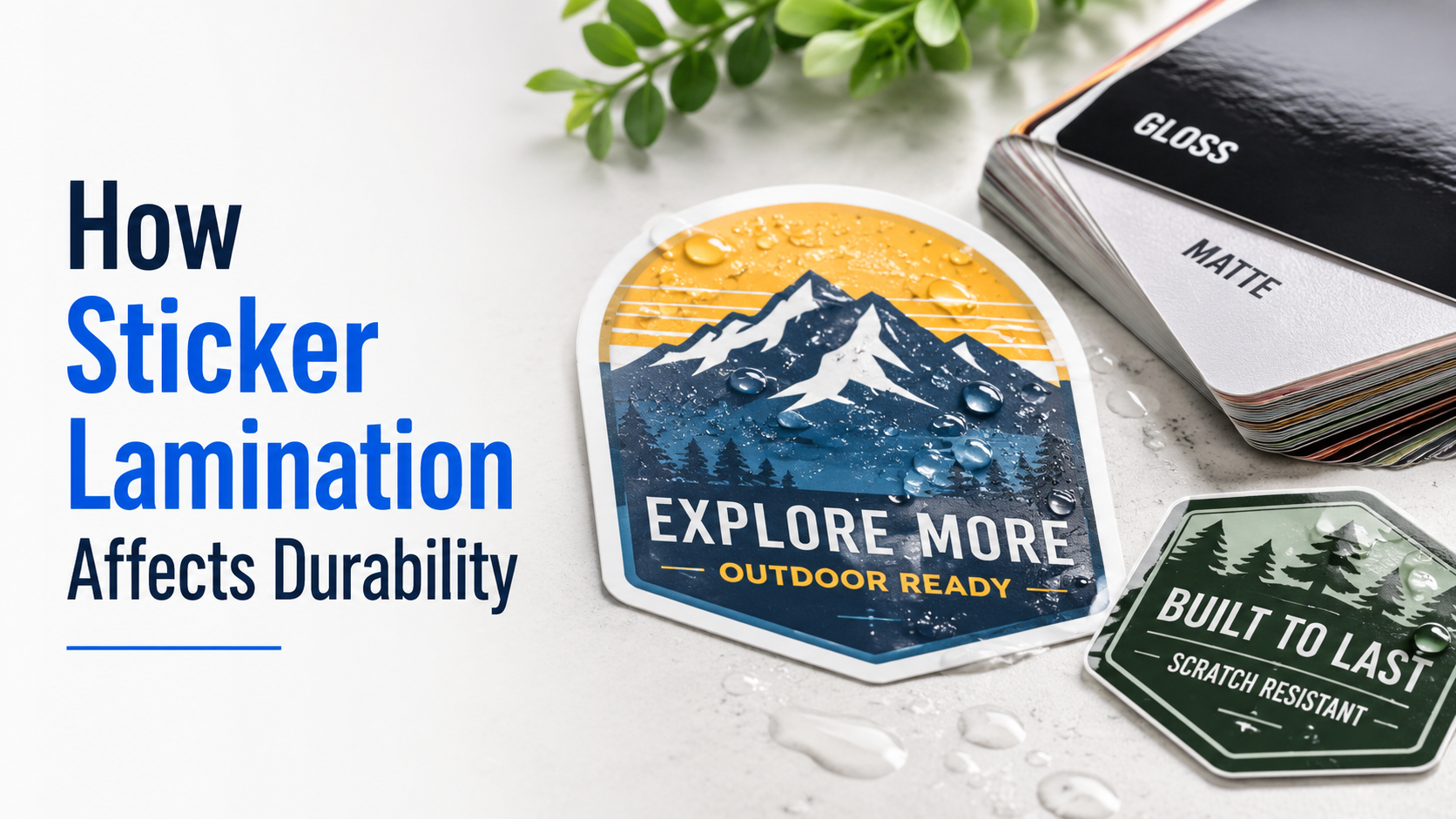
Sticker lamination affects durability by placing a transparent protective layer between the printed design and the conditions around it. That extra layer absorbs much of the wear that would otherwise reach the ink.
But lamination is not a force field. It improves a sticker’s resistance to common problems, while the vinyl, adhesive, ink, surface preparation, and environment still determine how long the sticker actually lasts.
What Is Sticker Lamination?
Sticker lamination is the process of applying a clear film or protective coating over a printed sticker.
A typical laminated vinyl sticker has several layers:
- Clear protective laminate
- Printed ink
- Vinyl face material
- Pressure-sensitive adhesive
- Release liner or backing paper
Once the backing paper is removed, the adhesive attaches the sticker to its final surface. The laminate remains on top of the print and becomes the first layer exposed to sunlight, water, friction, and handling.
Film lamination is common for durable vinyl stickers. A roll of clear adhesive film is pressed over the printed vinyl before the stickers are cut. Protective clear coats can also be applied as liquids, but those coatings may provide different levels of thickness, chemical resistance, flexibility, and outdoor life.
Manufacturers make overlaminates from materials such as vinyl, polyester, polypropylene, polyurethane, and other polymers. Each material has its own strengths. Some prioritize flexibility. Others focus on scratch resistance, UV protection, chemical resistance, or long outdoor exposure.
How Sticker Lamination Affects Durability
The simplest way to understand lamination is to look at the main causes of sticker damage.
Lamination Reduces Scratches and Surface Wear
Printed ink sits close to the surface of an unlaminated sticker. Repeated rubbing can gradually scratch, scuff, or remove parts of the printed image.
This matters on stickers used on:
- Water bottles
- Laptops
- Phone cases
- Toolboxes
- Helmets
- Equipment cases
- Vehicles
- Retail displays
- Frequently handled packaging
A laminate takes the first contact from keys, fingernails, bags, cleaning cloths, and other objects. The laminate itself can still become scratched, especially under rough use, but the printed image beneath it is better protected.
Avery Dennison describes protective overlaminate films as providing added abrasion resistance, while 3M offers different films designed for protection from abrasion, stains, gouges, and similar surface damage. The level of protection depends on the specific laminate rather than the presence of any clear film at all.
Lamination Helps Slow UV Fading
Ultraviolet light can gradually change printed colors. Reds, oranges, and some other bright colors may show fading before darker or more stable colors, though the exact result depends on the ink system and exposure.
A UV-resistant laminate helps filter some of the radiation before it reaches the printed image. This can extend the useful appearance of stickers placed on cars, storefronts, outdoor equipment, windows, and other exposed surfaces.
It does not make the print immune to the sun. A sticker facing direct sunlight every day will usually age faster than one placed indoors. Horizontal surfaces also tend to receive harsher exposure than vertical surfaces because they collect more direct sunlight, heat, moisture, and debris.
Commercial overlaminates are available with widely different outdoor ratings. Avery Dennison lists one polymeric gloss laminate with excellent UV protection and an outdoor life of up to five years. ORAFOL lists a high-performance polyurethane laminate with stronger UV and abrasion resistance and a stated durability of ten years when used within its specified system and conditions. These examples show why “laminated” alone does not tell you the full durability story.
Lamination Protects the Printed Face From Moisture
Water can damage some printed stickers by affecting the ink, face material, or bond between layers. Lamination places a water-resistant film over the printed face, reducing direct contact between moisture and the ink.
This makes laminated stickers a sensible choice for water bottles, coolers, bathroom containers, outdoor bins, food packaging, and products that may be wiped clean.
CustomStickers.com uses a weatherproof, UV-resistant laminate on its custom vinyl stickers, providing protection from scratches, water, and sunlight. The company currently rates those stickers for an effective outdoor life of five years under typical conditions.
But face lamination does not automatically seal the entire sticker.
Water may still reach the adhesive around an exposed edge. A damaged corner can provide another entry point. Long periods of submersion, steam, high-pressure washing, or repeated dishwasher cycles can be much harder on a sticker than occasional rain or hand washing.
“Waterproof” should therefore be considered in the context of the complete sticker construction and its intended use, not just the top laminate.
Lamination Helps With Dirt and Routine Cleaning
A smooth laminated surface is usually easier to wipe than exposed printed ink.
Dirt, fingerprints, oil, and light residue remain on top of the protective film rather than directly contacting the printed surface. This is useful for product labels, equipment decals, point-of-sale displays, and stickers placed in workshops or kitchens.
Chemical resistance varies considerably. One laminate may tolerate water and mild household cleaning products, while another is designed for stronger solvents, fuel exposure, graffiti removal, or industrial environments.
Do not assume that a standard sticker laminate will resist bleach, acetone, gasoline, strong alcohol, or concentrated cleaners. The laminate manufacturer’s chemical-resistance data should guide any demanding application. 3M, Avery Dennison, and ORAFOL all offer specialized overlaminates for conditions that go beyond ordinary sticker use.
Lamination Adds Thickness and Structure
A laminate makes the finished sticker slightly thicker and stiffer.
That can improve handling. Larger stickers may be easier to apply without folding onto themselves, and small stickers may feel more substantial when handed out at an event.
Extra structure can also help protect the printed surface during shipping and peeling. But thicker is not always better. A very rigid construction may struggle to follow tight curves, textured surfaces, compound bends, or flexible containers.
For a flat laptop lid, cooler, or window, moderate stiffness is rarely a problem. For a helmet, contoured vehicle panel, bottle shoulder, or flexible pouch, the laminate needs to conform along with the base vinyl.
The laminate and vinyl should be selected as a compatible system. Placing a stiff laminate over a highly flexible vinyl may create lifting, stress, or poor conformity around curves.
What Lamination Cannot Fix
Lamination protects the top of the sticker. It does not correct every cause of failure.
Weak or Incorrect Adhesive
A durable laminate cannot prevent a sticker from falling off if the adhesive is poorly matched to the surface.
Smooth glass, painted metal, low-energy plastic, unfinished wood, powder-coated equipment, and textured walls behave differently. Some surfaces require stronger or more specialized adhesives.
Dirty Application Surfaces
Dust, grease, wax, moisture, silicone, and cleaning residue can interfere with adhesion.
The surface should be clean and dry before application. And after cleaning, avoid touching the adhesive or cleaned surface with oily fingers.
A clear film can do many things. Negotiating with a greasy cooler is not one of them.
Poor Base Material
A strong laminate cannot make thin paper behave like outdoor vinyl. It may protect the top, but moisture can still enter through the paper edges or back.
The same problem applies to low-grade vinyl that shrinks, cracks, or becomes brittle faster than the laminate.
Exposed or Damaged Edges
Most die-cut stickers are laminated before they are cut. This leaves a clean edge where the laminate, ink, and vinyl layers are visible.
That construction works well for normal use, but it is not the same as fully encapsulating the design between two larger sealed sheets. Damage often begins around the edge because that is where moisture, cleaning, or picking can reach the individual layers.
Rounded corners and smooth cutlines can reduce snagging. Very sharp points and narrow extensions are more likely to catch on objects and begin lifting.
Poor Application
Bubbles, wrinkles, stretched vinyl, and partially attached edges create weak areas.
Apply the sticker gradually with even pressure. Pay particular attention to the perimeter. Curved surfaces may require a more flexible material than flat ones.
A Weak Link Elsewhere in the Sticker
3M notes that the durability of a finished graphic construction follows the component with the lowest rating. Adding a longer-lasting laminate cannot extend the complete graphic beyond the practical limits of its ink, base film, adhesive, or application.
That is the most important rule in the article.
Lamination matters, but the sticker is still a system.
Gloss vs Matte Lamination Durability
Gloss and matte describe the surface appearance of the laminate.
Gloss Laminate
Gloss laminate reflects more light and can make colors appear deeper, brighter, and more saturated. It works well for bold artwork, photographs, logos, and stickers designed to catch attention.
Its smooth surface may make fine scratches more visible under direct light, depending on the material.
Matte Laminate
Matte laminate reduces reflections and gives the artwork a softer appearance. It can improve readability in bright lighting and may hide fingerprints or fine surface marks better than a high-gloss finish.
Dark colors can appear slightly less deep under matte film, and very fine detail may look softer.
The finish alone does not determine durability. A matte and gloss version made from the same film family can offer similar protection. CustomStickers.com, for example, states that its matte and glossy laminated stickers use the same vinyl and provide the same durability.
But that is not a universal promise for every product on the market. Compare the actual film construction, UV rating, thickness, and intended application rather than assuming all gloss and matte laminates perform equally.
Are All Sticker Laminates Equally Durable?
No. Lamination quality varies.
Important differences include:
- Film material
- Film thickness
- UV stability
- Abrasion resistance
- Flexibility
- Adhesive chemistry
- Chemical resistance
- Temperature range
- Outdoor rating
- Horizontal or vertical use
- Compatibility with the printed vinyl
A promotional laminate intended for short-term signs is not the same as a high-performance film intended for vehicle wraps or long outdoor exposure.
Thicker films may improve physical protection, but thickness is only one measurement. A thin high-performance polyurethane or cast film may outperform a thicker low-cost film in sunlight, flexibility, or long-term stability.
The 3M product guide includes overlaminates ranging from roughly 25 to 100 microns, with different materials and outdoor ratings. The correct product depends on the application rather than simply choosing the thickest option.
When Laminated Stickers Are Worth It
Lamination is usually worth choosing when stickers will be exposed to weather, water, sunlight, repeated handling, or cleaning.
| Sticker Use | Lamination Priority | Main Reason |
|---|---|---|
| Water bottles | High | Moisture, handling, washing |
| Car windows and bumpers | High | UV, weather, road grime |
| Outdoor equipment | High | Sun, dirt, abrasion |
| Laptops and phone cases | High | Scratches and handling |
| Product containers | Medium to high | Moisture and cleaning |
| Shipping boxes | Medium | Scuffing and handling |
| Indoor wall stickers | Depends | Surface and expected lifespan |
| Temporary event stickers | Low to medium | Short period of use |
| Disposable packaging seals | Low | Limited lifespan |
| Write-on labels | Often low | Laminate may resist pens |
Unlaminated stickers can still make sense.
A paper label used on dry indoor packaging may not need years of protection. Temporary name tags, shipping labels, short-term promotional seals, and labels intended to be written on may work better without a standard plastic laminate.
The goal is not to add every available feature. It is to match the sticker to its environment.
Does Lamination Make a Sticker Dishwasher Safe?
Lamination helps, but it is only one part of dishwasher resistance.
A dishwasher exposes stickers to heat, water, detergent, spray pressure, and repeated expansion and contraction. Those conditions test the adhesive, vinyl, ink, laminate, and exposed edges at the same time.
For the best results:
- Apply the sticker to a clean, smooth surface.
- Press the edges down firmly.
- Allow the adhesive time to build its bond before washing.
- Avoid placing the sticker over seams or strong curves.
- Keep sharp design points to a minimum.
- Follow the printer’s care recommendations.
- Hand wash when preserving the sticker matters most.
A sticker that survives occasional hand washing may not perform the same way after dozens of dishwasher cycles. Ask the printer about the complete product, not only whether it is laminated.
Why Sticker Laminate Sometimes Peels
When the laminate separates from the printed vinyl, the problem is called delamination.
Possible causes include:
- Poor bond between the laminate and print
- Contamination during production
- Lamination pressure that was too low
- Improper temperature during production
- Incompatible ink, vinyl, and laminate
- Solvent ink that was not given enough time to outgas
- Extreme heat
- Repeated moisture entering from the edge
- Excessive flexing
- Physical picking or abrasion
Small bubbles or a hazy silver appearance can also occur when the laminate does not make full contact with the printed surface. Manufacturers recommend controlled pressure and, for some UV-printed graphics, limited heat assistance to improve contact and reduce trapped air.
A professionally laminated sticker should arrive with the film smooth and firmly bonded to the print.
How to Choose a Durable Laminated Sticker
Before ordering, ask a few practical questions.
What Is the Face Material?
Vinyl is generally the standard choice for durable outdoor stickers. Paper and some label films are better suited to shorter indoor applications.
Is the Sticker Actually Laminated?
Some printers describe ink as weather-resistant without adding a separate protective film. That may be adequate for certain uses, but it is not the same construction as a film-laminated sticker.
What Does the Outdoor Rating Cover?
Ask whether the stated life applies to the complete printed sticker or only to the unprinted vinyl or laminate.
Is the Rating for Vertical or Horizontal Exposure?
A sticker on a vertical window may last longer than the same sticker placed flat on the hood of a vehicle.
Is the Laminate Glossy or Matte?
Choose based on appearance and readability, then verify that the durability fits the intended use.
What Cleaning Products Are Safe?
This matters for industrial labels, food-service equipment, cleaning bottles, tools, and vehicles.
Can You Test a Sample?
Testing is useful when the sticker will be applied to a difficult plastic, textured finish, coated surface, or frequently washed item.
Laminated Sticker Durability Checklist
Before ordering durable stickers, confirm:
- The face material suits indoor or outdoor use.
- The sticker includes a protective laminate.
- The laminate provides UV protection.
- The laminate offers enough abrasion resistance.
- The adhesive is suitable for the intended surface.
- The material can follow any curves or contours.
- The cutline avoids unnecessarily fragile points.
- The sticker can tolerate the expected cleaning method.
- The stated lifespan applies to the complete construction.
- The surface will be cleaned before application.
- A sample has been tested for demanding applications.
Frequently Asked Questions
Do Vinyl Stickers Need Lamination?
Not every vinyl sticker needs lamination, but stickers exposed to sun, water, rubbing, or frequent handling benefit from it. Short-term indoor stickers may perform adequately without a laminate.
How Much Longer Do Laminated Stickers Last?
There is no single multiplier. Lifespan depends on the laminate, ink, vinyl, adhesive, exposure direction, climate, surface, and care. Commercial laminate ratings range from short promotional use to many years outdoors.
Does Lamination Stop Stickers From Fading?
It slows fading when the laminate includes effective UV protection. It cannot stop fading forever, especially in constant direct sunlight.
Are Matte Laminated Stickers Less Durable Than Glossy Stickers?
Not necessarily. Matte and gloss versions can offer comparable durability when made from the same film system. Check the specifications for the exact product.
Can Laminated Stickers Still Scratch?
Yes. Laminate improves scratch resistance, but enough friction or contact with sharp objects can mark or cut the surface.
Does Lamination Prevent Sticker Edges From Peeling?
It can add structure and protect the face, but edge lifting is usually connected to adhesive choice, surface preparation, cutline shape, application, or moisture reaching the edge.
The Laminate Is Only One Layer
Sticker lamination makes a real difference.
It protects printed ink from common sources of damage and helps stickers remain readable and presentable through weather, sunlight, scratches, moisture, dirt, and routine handling.
But durable stickers require the layers to work together. A strong laminate placed over weak vinyl will not produce a strong sticker. Neither will good materials applied to a dirty or unsuitable surface.
Choose the laminate based on the actual use. Match it with quality vinyl, suitable adhesive, properly cured ink, and careful application.
That combination does far more for sticker durability than any single feature printed on a product page.